As of 2020, the plant is co-fired with about 62% biomass (delivered by around 60 heavy goods vehicles per day), of which 336,000 energy tonnes (or 80%) is Irish.
The station has a target of 100% biomass by 2023.
The ash is sent by rail and deposited at the adjacent Cloncreen bog near Clonbullogue (alternative source suggests c. 32,000 tonnes/year goes to licensed landfill)
Water 220m3/hour abstracted from river Figile at Clonbullogue
The JNCC National Soil Map indicates that 24.6% of NI is covered by peat.
A new peat map was developed by the Centre for Ecology and Hydrology (CEH) in 2017 based on the British Geological Survey (BGS) superficial geology dataset, the Agri-Food and Biosciences Institute (AFBI) soil survey, and the 1988 NI peat survey.
The CEH mapping identified a total peat extent of 242,622 ha
It is estimated that 86% of NI’s peatlands are in a degraded state due to drainage, overgrazing, afforestation, burning and extraction
Summary of peatland categories and conditions in NI. A baseline of 2007 was used.
Source: CEH (2017)
In NI, the power to grant permission for industrial peat extraction lies with the planning authorities.
DAERA is a statutory consultee, but does not hold information on the location or current and projected extraction rates from approved sites
There is currently no national peatland strategy for NI, however the DAERA Minister, Edwin Poots, has stated that a NI peatland strategy is being developed
Approximately 1% of NI’s peatlands have been restored in the past 30 years
DAERA have committed to the following initiatives to support the restoration of peatland habitats and ecosystems in NI77;
– The Environment Fund and its Challenge Funds – A Green Recovery Challenge Fund is under development for 2021/22; – The development of a Resilient Peatland Programme; – The development of future Agri-Environment schemes; – The implementation of the “Forests for our Future” programme; and – The development of new EU Peace Plus Programme 2021-27
Republic of Ireland
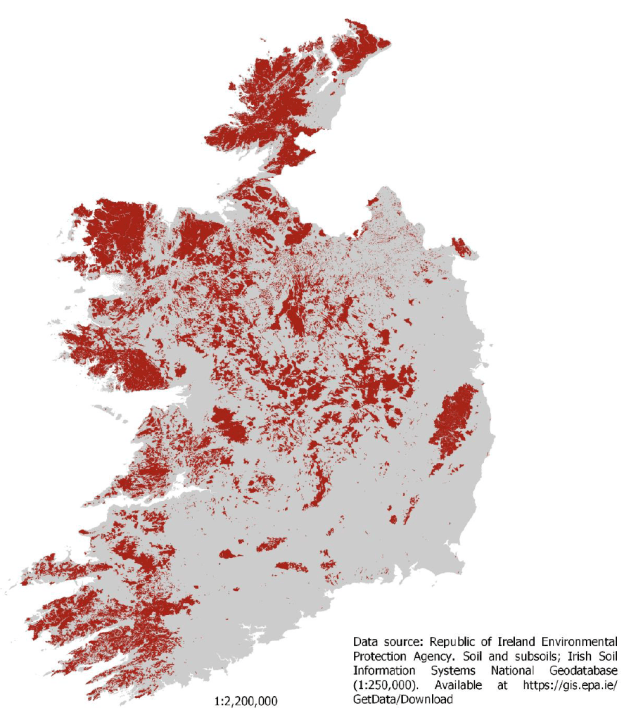
Peat soils cover ~21% of the RoI, with a total peatland area of 1,564,650 hectares (figure 5). RoI has a comparable peatland coverage to Scotland.
It is estimated that only 10% of raised bogs and 28% of blanket bogs are in a natural state.
Summary of the peatland habitats in RoI and their condition:
Looking at HS 2703 for Northern Ireland which is “Peat (including peat litter), whether or not agglomerated” there have been €17,073,647 worth of imports and €7,411,179 worth of exports in January to August 2021 (August being the latest month for which data is available).
Almost 40,000t of peat was imported into Ireland from eight different countries during the first seven months of this year, new data reveals.
The Department of Agriculture data, obtained by this publication, includes peat imported for fuel (peat briquettes) and peat imported for use in the horticulture sector.
It shows that between January and July this year a total of 39,443t of peat (to the value of €6.7m) was imported into Ireland, this compares to 10,437t of peat (to a value of €3.2m) imported over the 12-month period of 2020 – marking an almost 300pc increase.
The countries of origin for the peat imported up to July this year include: Northern Ireland (36,714t), the Netherlands (1,112t), Great Britain (901t), Germany (415t), Lithuania (214t), Ukraine (55t), Belarus (22t), plus 9t imported from an unknown non-EU country.
A peatland restoration project across extensive upland bog and heathland is to be undertaken at the famous Luggala estate in the Wicklow mountains.
Luggala Estate Limited said it was “starting its response towards addressing the climate and biodiversity emergencies” through the initiative, which would see 1,300 hectares of peatlands restored over several years.
The peatlands on Luggala are made up of blanket bog, wet heath and dry heath habitats. Peat harvested on Luggala provided fuel during the “emergency” in the second World War. Areas mainly close to the upland roads were drained for peat extraction, removing surface vegetation in the process.
There was extensive drainage of peatlands in subsequent decades, linked to an effort to improve grazing or to prepare land for forestry. This has significantly affected the hydrology and integrity of the peatlands in those areas, with the habitats drying out. The added pressure of grazing by deer and sheep also dramatically affected its condition from a habitats perspective.
“This is an ambitious project that will take many years to complete. We will start with detailed ecological and hydrological studies, then focus on a target of restoring 150 hectares of blanket bog and improve heathland management on a further 150 hectares of wet and dry heath,” said Anthony Blanchfield, environment manager at Luggala.
The restoration project, taking place over the coming months, will see 60 hectares of drained bog re-wetted to increase water storage levels in part of the River Liffey headwaters by an expected 50-90 million litres. These headwaters supply the Poulaphouca (Blessington) reservoir, a drinking water source for the Greater Dublin Area. The bog restoration will also protect biodiversity, improve carbon storage, and is likely to improve water quality.
The first phase of this project will involve:
Baseline studies, including scoping surveys of potential sites for management in the WMNP and ecohydrological characterisation of selected pilot sites and restoration planning design.
Restoration works, principally re-wetting the bog through drain blocking to raise the lowered water levels. This will provide conditions to enable recovery of the main peat-forming species, especially the Sphagnum mosses.
Pre- and post-restoration monitoring to quantify the project’s impact on vegetation, carbon storage, water levels and any improved water storage capacity in study sites.
Quantification of Blanket Bog Ecosystem Services to Water (QUBBES) is an EPA funded research programme
This EPA-funded research project to quantify blanket bog ecosystem services (QUBBES) is currently investigating this issue and seeks to develop an approach(es) for blanket bog management that can facilitate existing economic activities, while deriving maximum benefit from ecosystem services.
Research will continue for the next 2.5 years, in which it will compare hydrological and water quality conditions in relatively intact sites with those from catchments where forestry/peat cutting/upland agriculture occurs, along with areas where restoration has been carried out.
NEtwork monitoring Rewetted/restored peatlands and Organic Soils for climate and biodiversity benefits
The NEROS project was funded by the EPA for two years starting January 2013 to set up a monitoring network of re-wetted/restored peatlands and organic soils in order to appraise their climate and biodiversity benefits.
Hypotheses
1) The current state of degradation of Irish peat soils will only deteriorate further without intervention – this will lead to further loss of ecosystem services including the regulating services (climate (C sequestration and C storage), water regulation as well as erosion protection), the cultural services (recreational, aesthetic, spiritual and educational) and the supporting services (biodiversity, soil formation, nutrient cycling)
2) Re-wetting and restoring peatlands and organic soils are co-benefit measures, complementary to nature conservation and protection which can enhance biodiversity and restore biogeochemical functions that are vital for the delivery of ecosystem services and a sustainable environment
3) By fully exploiting the synergy potential of the climate change-biodiversity nexus, re-wetting and restoring peatlands and organic soils will facilitate Ireland’s legal requirements under EU Directives and national legislation (Habitats Directive, Birds Directive, Flora Protection Orders, the CBD, Water Framework Directive and Landscape Directive)
Objectives
This project will establish a network of both degraded and re-wetted and restored peatlands throughout Ireland where we will be monitoring GHG fluxes and biodiversity components. The ultimate aim is to provide high quality information to guide policy decisions in recognising the climate change-biodiversity nexus and its benefits in facilitating Ireland’s commitment to a more sustainable environment through the reduction of GHG emissions and conservation and sustainable use of a natural resource.