Kerdiffstown Landfill Remediation Project
Landfill and waste facilities
Ballynagran Landfill
Ballynagran, Coolbeg and Kilcandra, Wicklow.
(W0165-02)


Ballynagran is an operational landfill in Co. Wicklow. It accepts residual nonhazardous, commercial and industrial waste.
Storm water is collected in an attenuation lagoon prior to discharge to the Ford Stream, a tributary of the Three Mile River, via reed beds.
Process waste water is collected in a leachate collection lagoon prior to removal from site via tankers to suitable Waste Water Treatment Plants. There is no discharge of treated wastewater to surface water or
groundwater.
Leachate collected in the leachate collection lagoon is monitored quarterly and is analysed for a number of parameters as required by the licence.
Groundwater monitoring is undertaken at 16 locations within the facility. These are located hydraulically upgradient and downgradient of the landfill. The groundwater is analysed for a number of parameters as required by the licence.
EPA documents
Biostabilisation: monitoring of bio-stabilised residual waste
Biostabilisation working group comprising Dept. of Env., EPA/WERLA and Industry compiling new
guidelines on the biostabilisation process including inputs/outputs and sampling requirements
Ballynagran Landfill (Wicklow) response to EPA finding on non-compliance

Biostabilised Organic Fines
In 2019, five composting facilities in Ireland accepted organic fines for biostabilisation. Organic fines arise from the mechanical treatment of residual waste. There has been a notable rise in the treatment of organic fines at composting plants in Ireland, up from around 50,000 tonnes in 2013 to 138,000 tonnes in 2018 and 152,000 tonnes in 2019. This reflects the fact that most residual waste in Ireland is now pre-treated mechanically at waste facilities, for example by trommelling, before it is sent for recovery or disposal. The organic fines arising from this pre-treatment process undergo biostabilisation to reduce their biological activity to an EPA-approved standard. The biostabilised fines can then be used as landfill cover or disposed of at landfill without giving rise to odour and greenhouse gas emissions.
BMW reporting module in EPA EDEN system
BMW stands for biodegradable municipal waste.
General information with regard to the BMW reporting module: Biodegradable Municipal Waste (BMW) Reporting | Environmental Protection Agency (epa.ie)
In relation to what happens to the information that landfill operators submit to the EPA – this comes into an internal system that is used by the EPA to manage the issuing and enforcement of EPA licences and other EPA authorisations.
Some of the information held in this system is published to the EPA website (e.g. Annual Environmental Reports, Site Inspection reports), and other information is made available at EPA offices (e.g. via a user interface called LEAP).
Summary information relating to the BMW data returns is already published on the EPA website here: ‘First Look’ Data | Environmental Protection Agency (epa.ie)
There are three active municipal waste landfills accepting waste in Ireland at present – Knockharley Landfill (W0146-02), Drehid Landfill (W0201-03) and Ballynagran Landfill (W0165-02).
Should public wish to see more specific information/data about the three landfills, each of these landfills operates under an Industrial Emissions (IE) licence, so they can find more specific information by searching for the relevant licence here:
Search for a Licence/Permit | Environmental Protection Agency (epa.ie), and then clicking on the “View Licence Enforcement Documents” button.
The “BMW Reporting Module” in EDEN is not a dataset, and there is no facility to view landfill data on that module, other than any data returns that someone has previously submitted to the EPA for a landfill under their control.
The BMW reporting module is only a mechanism for landfill operators to submit specific information to the EPA on municipal waste acceptance which is required to be submitted under the conditions of their licence.
Knockharley Landfill
Knockharley, Navan, (Includes Townlands of Tuiterath & Flemingstown), Meath
Knockharley Landfill is an operational landfill facility. It covers an area of 135 hectares approximately. It accepts residual non-hazardous, commercial, and industrial waste.
Wastewater from the landfill (Leachate) is collected in a leachate lagoon prior to removal from site via tankers to suitable Waste Water Treatment Plants for treatment. There is no discharge of treated wastewater to surface water or groundwater.
EPA documents
https://epawebapp.epa.ie/licences/lic_eDMS/rss/W0146-02.xml
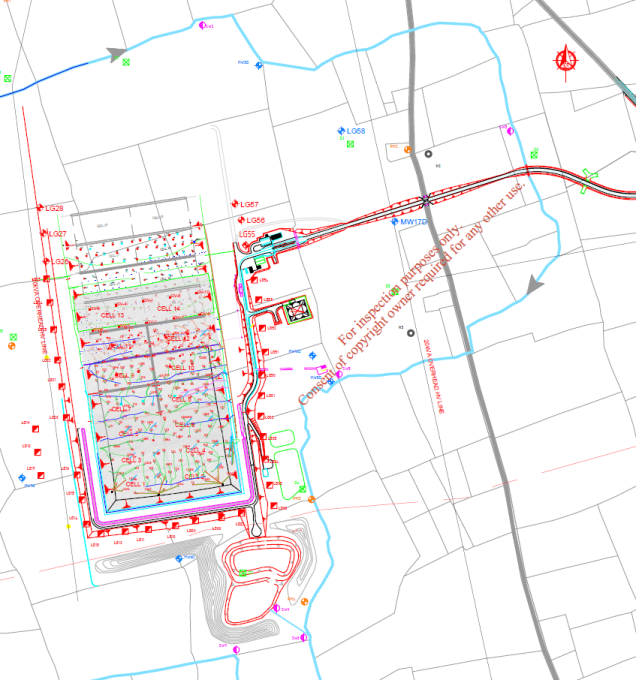
The monitoring programme includes groundwater, surface water, leachate, landfill gas, landfill gas utilisation plant, meteorological, volatile organic compounds, biological, noise, PM10 and dust monitoring, as specified in its Industrial Emissions Licence (No.W0146-02).
The Licence specifies eight monitoring locations (SW1, SW2, SW3, SW5, SW6, SW7, SW8 and SW9 (Wetland). Sampling points SW1, SW2 and SW3 are upstream of the facility, SW-5 is side-on to the facility and SW6, SW7 and SW8 are downstream. SW9 is the discharge point from the wetland.
EDEN Walkthrough – what data is collected by the EPA when a waste operator / local authority submits an Article 11 request (for Waste Disposal and Recovery Activities)
Waste Management (Facility Permit and Registration) Regulations, 2007, Amended by the Waste Management (Facility Permit and Registration)(Amendment) Regulations, 2008
Request under Article 11 of the Regulations to the Environmental Protection Agency for determination as to whether an activity requires a waste licence, waste facility permit, certificate of registration or none of these
Note from EPA: You must have following information to-hand before completing the Article 11 Request form.
- Contact email address.
- Grid Reference (Eastings & Northings).
- Site map, showing outline of site of proposed activity.
- The Authorisation or Registration Number if you have existing authorisation i.e. Waste/IPPC Licence, Waste Permit, Certificate of Registration.
- The Reference Number if you have submitted a previous Article 11 request.
- Description of Waste, including:
- Solid or Liquid
- European Waste Catalogue (EWC) Code
- Annual intake in tonnes
- Annual intake in litres
- Source of Waste
- The amount, in tonnes and litres, of ‘residual waste’ remaining after recovery that is to be sent on for disposal.
- Whether ‘biological treatment’ is involved in the proposed activity.
- For biological treatment processes, the quantity of biowaste, digestate and compost, as relevant, in tonnes and cubic metres that will be present at the facility at any one time.
- For land deposition/reclamation/restoration activities, the amount of waste (in tonnes) to be deposited over the operational lifetime of the activity.
- Information related to Planning – planning reference number or evidence of exemption.
- Information on Designated Sites, where applicable (e.g. Special Areas of Conservation, Special Protection Areas, Ramsar sites, Natural Heritage Areas). Information should include:
- Site Name
- Site Code
- Confirmation as to whether or not the site of the proposed activity is in, or next to, a wetland.
Local Authority- Do I need a Waste Licence or Certificate of Registration
Private Sector – Do I need a Waste Licence, Permit or Certificate of Registration


Drop down for “Source of Waste” is as follows:
Construction & Demolition
Municipal (Household & Commercial)
Household
Commercial
Gardens & Parks
Industrial
Agricultural
Healthcare
Waste Management Industry
Other


For more details see
https://www.epa.ie/our-services/licensing/waste/declaration-on-waste-authorisations-art-11/
FAQs
https://www.epa.ie/resources/faqs/waste/general-article-11-questions/#d.en.84156
Database for waste facility permits and certificates of registration
The Waste Facility Permit and the Certificate of Registration Database is a register for waste facility permits and certificates of registration issued by local authorities under the Waste Management (Facility Permit and Registration) Regulations, S.I. No. 821 of 2007, as amended. This website is a central register hosted by the National Waste Collection Permit Office (NWCPO) of all waste facility permits and certificates of registration granted, reviewed, revoked and expired. The database can be accessed at the following link: http://facilityregister.nwcpo.ie/
Sample waste permit
http://facilityregister.nwcpo.ie/details.aspx?recordId=39567
Industrial and Waste Licence Enforcement – 2021 Summary Report
Report provide summary details of the OEE’s enforcement activities at licensed industrial and waste sites for 2021

EPA / AECOM Landfill Leachate Study
EPA / AECOM leachate samples study from six landfill sites (three operational and three historical)
Sites were selected based on historic and operational landfills at EPA licensed sites as opposed to illegal or historically unlicensed landfills.
The sites selected were:
· Site 01 – Drehid Waste Management Facility, Co. Kildare (Operational Landfill);
· Site 02 – Ballymurtagh Landfill Facility, Co. Wicklow (Historical Landfill);
· Site 03 – Knockharley Landfill, Co. Meath (Operational Landfill);
· Site 04 – Ballynagran Residual Landfill, Co. Wicklow (Operational Landfill);
· Site 05 – Kerdiffstown Landfill, Co. Kildare (Historical Landfill); and
· Site 06 – Arthurstown Landfill, Co. Kildare (Historical Landfill).
Sample record

Remediation of landfill sites
At July 2020, the total number of identified landfill sites was 611
This included
– 117 sites licensed and regulated by the EPA since March 1997, and which it continues to monitor – consisting of 64 sites operated by local authorities and 53 operated privately.
– 494 unregulated sites registered by local authorities on a web-based register established by the EPA. Over 70% of the sites are former local authority-operated landfills. Around 21% were privately operated sites, while just over 8% were illegal dump sites

By the end of 2019, all 280 of the post-1977 local authority sites on the Section 22 register had been risk assessed and all but one had been categorised. Over half of the sites were assessed as either high risk or moderate risk.
Neither the EPA, nor the Department, nor the regional waste management planning offices were able to provide the examination team with complete information on the risk assessment status of the remaining 214 sites on the Section 22 register as at 31 December 2019.

Recommendation 1
The Department should conduct a comprehensive review of governance arrangements related to landfill sites to ensure that responsibilities for oversight and monitoring of landfill sites are clearly defined and assigned to ensure that appropriate steps to eliminate risks to the environment and communities are taken in a timely and efficient manner.
Recommendation 2
The Department should develop proposals for ensuring that all outstanding risk assessments are completed on a timely basis and that remediation plans are put in place as a matter of priority in respect of those landfill sites which are assessed as of either moderate or high risk.
Recommendation 3
The Department should develop medium term estimates of the future costs associated with landfill remediation.
Download Report here:
Closed / Historic Landfills
A ‘closed landfill’, also commonly referred to as a historic landfill, is defined in the said Regulations as a landfill site operated by a local authority for the recovery or disposal of waste without a waste licence on any date between 15th July 1977 and 27th March 1997.
The Environmental Protection Agency is obliged to process applications from local authorities in relation to ‘closed landfills’ in accordance with the Waste Management (Certification of Historic Unlicensed Waste Disposal and Recovery Activity) Regulations, 2008.
The purpose of certificates of authorisation is to specify control and remediation measures required at a closed landfill to ensure that waste disposed or recovered in the closed landfill is not causing, or is not likely to cause, environmental pollution. A certificate of authorisation shall comply with the above Regulations.
Before making an application for a certificate of authorisation, a local authority has to identify and register the closed landfill in accordance with the Regulations. The local authority shall then carry out a risk assessment in respect of the closed landfill in accordance with the EPA Code of Practice – Environmental Risk Assessment for Unregulated Waste Disposal Sites and the Regulations (Regulation 6). Once the risk assessment has been completed, the local authority apply to the EPA for a certificate of authorisation (Regulation 7).
As of Jan 2022, there are 69 registered Historic Landfills
You can search the dataset of Historic Landfills here:
Or click on a specific Landfill Facility here:
| Reg No. | Applicant | Location of Facility | Documents? |
|---|---|---|---|
| H0125-01 | Donegal County Council | Dunkineely | Yes |
| H0141-01 | Donegal County Council | Carrick | Yes |
| H0167-01 | Fingal County Council | Barnageeragh | Yes |
| H0171-01 | Galway City Council | Southpark | Yes |
| H0175-01 | Galway County Council | Shore Road | Yes |
| H0176-01 | Galway County Council | Clifden – Tullyvogheen | Yes |
| H0181-01 | Galway County Council | Gort | Yes |
| H0188-01 | Galway County Council | New Inn | Yes |
| H0192-01 | Galway County Council | Tuam | Yes |
| H0194-01 | Kerry County Council | Ahasara | Yes |
| H0195-01 | Kerry County Council | Ardfert | Yes |
| H0198-01 | Kerry County Council | Castleisland | Yes |
| H0203-01 | Kerry County Council | Dingle | Yes |
| H0204-01 | Kerry County Council | Lenamore | Yes |
| H0205-01 | Kerry County Council | Listowel | Yes |
| H0208-01 | Kildare County Council | Greenhills | Yes |
| H0209-01 | Kildare County Council | Prusselstown | Yes |
| H0002-01 | Wexford County Council | Carcur Landfill | Yes |
| H0003-01 | Waterford City & County Council | Portlaw (Coolfin) Landfill | Yes |
| H0005-01 | Limerick City Council | St Marys park Limerick | Yes |
| H0007-01 | Cork County Council | Pike Landfill | Yes |
| H0008-01 | Cork County Council | Velvetstown Landfill | Yes |
| H0009-01 | Waterford County Council | Townspark East, Lismore, Co. Waterford | Yes |
| H0030-01 | Clare County Council | Kilrush | Yes |
| H0035-01 | Clare County Council | Whitegate | Yes |
| H0077-01 | Cork County Council | Clountreem Landfill | Yes |
| H0081-01 | Cork County Council | Clonakilty | Yes |
| H0082-01 | Cork County Council | Cloyne | Yes |
| H0084-01 | Cork County Council | Dunmanway | Yes |
| H0223-01 | Kildare County Council | Digby Bridge | Yes |
| H0228-01 | Kildare County Council | Pollardstown Refuse depot, Loughbrown, The Curragh | Yes |
| H0231-01 | Kilkenny County Council | Thorpes | Yes |
| H0237-01 | Kilkenny County Council | Oldcourt | Yes |
| H0246-01 | Laois County County | Wynne Park Landfill | Yes |
| H0253-01 | Laois County Council | Trumera | Yes |
| H0259-01 | Laois County Council | Oughaval | Yes |
| H0296-01 | Longford County Council | Ballymulvey | Yes |
| H0302-01 | Longford County Council | Cartron Big | Yes |
| H0307-01 | Louth County Council | Omeath Town Dump | Yes |
| H0353-01 | Meath County Council | Jenkinstown Dump | Yes |
| H0357-01 | Meath County Council | Oldcastle Town Dump | Yes |
| H0363-01 | Monaghan County Council | Scotch Corner | Yes |
| H0424-01 | South Dublin Co Co | Waterstown | Yes |
| H0432-01 | South Tipperary County Council | Kilsheelan, Clonmel | Yes |
| H0456-01 | Westmeath County Council | Moate | Yes |
| H0364-01 | Monaghan County Council | Killycard | Yes |
| H0366-01 | Monaghan County Council | Killycronaghan | Yes |
| H0394-01 | Roscommon County Council | Castlerea | Yes |
| H0319-01 | Mayo County Council | Claremorris | Yes |
| H0306-01 | Louth County Council | Carlingford | Yes |
| H0277-01 | Limerick City & County Council | Knocknacarriga | Yes |
| H0291-01 | Limerick City & County Council | Churchtown Landfill | Yes |
| H0474-02 | Wicklow County Council | Fassaroe 3C | Yes |
| H0475-01 | Wicklow County Council | Fassaroe 2 | Yes |
| H0476-01 | Wicklow County Council | Fassaroe 3B | Yes |
| H0001-01 | Cork County Council | Newmarket Landfill | Yes |
| H0477-02 | Wicklow County Council | Fassaroe 3A | Yes |
| H0233-01 | Kilkenny County Council | Shermans | Yes |
| H0235-01 | Kilkenny County Council | Gowran | Yes |
| H0089-01 | Cork County Council | Kealanine Landfill | Yes |
| H0016-01 | Cavan County Council | Kingscourt Dumping Ground | Yes |
| H0020-01 | Cavan County Council | Cootehill | Yes |
| H0022-01 | Cavan County Council | Mullagh | Yes |
| H0006-01 | Sligo County Council | Former Finisklin Landfill | Yes |
| H0004-01 | South Tipperary County Council | Tipperary Landfill, Carrownreddy, Tipperary Town, County Tipperary | Yes |
| H0210-01 | Kildare County Council | Carigeen, Clane | Yes |
| H0477-01 | Wicklow County Council | Fassaroe 3A, Bray, County Wicklow | Yes |
| H0402-01 | South Dublin County Council | Bohernabreena | Yes |
| H0474-01 | Wicklow Co Council | Fassaroe 3C | Yes |
Safety concerns mean old landfill sites will continue to cost taxpayers money
“As of July 2020, the total number of identified landfill sites was 611. By the end of 2019, only three privately operated landfills were still in operation, the report said. They included 117 sites licensed and regulated by the EPA since March 1997, and which it continues to monitor — 64 sites operated by local authorities and 53 operated privately. Some 494 unregulated sites are registered by local authorities on a web-based register established by the EPA.”
The report said that the Environmental Protection Agency (EPA) monitors environmental risk factors on an ongoing basis on the 117 landfill sites it has licensed and regulated since March 1997.
The EPA does not monitor environmental risk factors at the remaining 494 landfills that have been identified by the local authorities and are registered on an EPA-hosted database.
More than half of the 280 sites operated by local authorities and subsequently closed between June 1977 and March 1997 have been assessed as of either moderate or high risk, the report found.
Remediation plans have been submitted to the EPA in only 29 of the 280 sites.
“Neither the EPA, nor the department, nor the regional waste management planning offices were able to provide the examination team with complete information on the risk assessment status of the remaining 214 sites on the register as at December 31, 2019, which included pre-1977 local authority sites, private sites and illegal sites,” the report stated.
https://www.irishexaminer.com/news/arid-40057541.html
Note: generally each historic landfill has an environmental screening report. Where a report is available, it’s generally an AA Screening Report, and can be difficult to locate on the EPA website. Click on the relevant Landfill Reg No (eg H0006-01), then click on View Applicant Documents. It is usually the largest file in the list
Note: Appropriate Assessment Screening is required under the Habitats Directive for any project or plan that may give rise to significant effects on a European (Natura 2000) site. The reports do cover water quality. They also cover potential cumulative effects, eg Ardfelt Quarry is less than 2km from Ardfelt Historic Landfill, and hydrologically linked
Examples of Appropriate Assessment Screening Reports prepared on behalf of local authorities on historic landfill sites
Dunkineely Landfill, Donegal
Carrick Landfill, Donegal
Barnageeragh Landfill, Dublin
Southpark Landfill, Galway