Owvane Priority Area for Action Desktop Report

Feb 2020

LAWPRO

The Owvane River (also known as White river and Abha Bhan river) rises in County Limerick to the north of Carrigkerry townland and flows north through Ballyhahill into the Shannon estuary at Loghill.


Land use, soil type and PIP maps indicate that the significant issue impacting on water quality at this site is most likely to be sediment and/or ammonia from forestry on peat


Lands to the south are mainly under forestry and the soil type is peat (see Appendix I and II). Streams in Owvane_010 (headwaters upstream of the PAA) flow mainly through forested areas with blanket peat.

Cloonlahard stream on Owvane_030 also flows through forestry and peaty soil. Felling records would be useful for the upstream lands to assist in determining whether forestry is a significant pressure here.

Forestry, peat and point sources from farmyards 

Landfill
There is one large point source on Owvane, Gortadroma landfill, located a short distance upstream of the WFD monitoring point at West Bridge. However, the landfill is closed and capped and phosphate would not normally be associated with landfill leachate so this facility is unlikely tobe a significant pressure here.


Ballyhahill wastewater treatment plant

S4 facility ?


Felling history in the catchment upstream of Cloonlahard

Inny Priority Area for Action Desktop Report

Jan 2020

LAWPRO

All four waterbodies have deteriorated since the first WFD cycle, dropping from good to moderate ecological status. As such they are At Risk of not meeting their WFD objectives (good status).

It is not evident what the significant issues are.

The semi-natural habitat in the area is open heath and blanket bog; however, much of the land has been converted to forestry, pasture and peat extraction. There are also four licensed quarries in the area and a fish farm in Ballinskelligs Bay (Marine Harvest).

Drainage associated with pasture, afforestation and peat extraction and phosphate release from agriculture and forest clear felling are potential pressures. As a result, the main issues are likely to be siltation of the channel bed and enrichment by phosphate (P) (and potentially nitrogen also).

Two water bodies are failing to meet their protected area objectives for salmon.

Potential source is fertiliser applications to reclaimed land along the river channel and phosphate release from recent felling

The areas of highest potential for diffuse phosphate runoff are ‘improved’ agricultural lands that occur on alluvial soils along the main river channel and localised areas of poorly draining mineral soils throughout the catchment

Drainage associated with pasture, afforestation and peat extraction is causing hydromorphological changes.

Potential for diffuse phosphate from agriculture and forest clear-felling.

Group Water abstractions

(Maulin PWSS 066H); River WB abstraction (Maulin PWSS 066H)

Last EPA audit for Maulin water abstrction was 2015

https://www.epa.ie/publications/compliance–enforcement/drinking-water/audit-reports/kerry/maulin-public-drinking-water-supply.php

Quarries:

QY 135 (now closed), https://www.epa.ie/ei/#/details/QS1295 Foilmore Quarries Ltd, Keelnagore, Cahersiveen, Kerry ( location: 51.936653546978974, -10.105066567681178 )

QS-0132 maybe mistake, as listed as concrete operations in Monaghan, (also on map as 01302 which is not on EPA quarry register)

QS 01251 https://www.epa.ie/ei/#/details/QS1251 Derreennageeha, Kerry

QY 036 https://www.epa.ie/ei/#/details/QS1233 Dromaragh, Waterville, Kerry

Bleach & Lough Graney Priority Area for Action Desktop Report

March 2020

LAWPRO

The PAA is located within the Shannon- Graney/Scarriff margaratifera sensitive area (i.e. catchment with previous records of margaritifera but current status unknown).

Land use is mainly forestry. Forestry is the sole significant pressure on this waterbody.

The significant issue impacting on water quality prior to the 2014 decline is likely to have been sediment and the significant pressure was forestry (probably felling, given the low level nutrient peaks observed).
Lough Graney (At Risk)


Moderate ecological status since monitoring commenced in 2007. Status is driven by macrophytes.


Land use in the sub-basin is mainly agriculture with some forestry to the west and north. Agriculture, and forestry are likely the significant pressures on this lake.


The significant issue impacting on water quality is most likely to be phosphorus.

Stream walks are required to identify whether pathways exist between forested areas and the river/its tributaries

Additional information requirements


Talk to Forest Service staff to obtain more detailed information on felling, particularly in the Bleach_010 headwaters during the period Summer 2012 to Summer 2014.


Also obtain information on aerial fertilization programmes undertaken here in the past.

Moynalty Priority Area for Action Desktop Report

1/1/20

The Moynalty Priority Area for Action (PAA) is located in north-west County Meath, approximately eight km’s north of Kells, near the border with County Cavan.

The PAA covers an area of approximately 161km2 and includes the towns of Moynalty and Mullagh. Within the PAA, there are two rivers: the Borora or Moynalty River and the Mullagh River along with several large tributaries.

The PAA is bordered to the north by the Kilmainham Dee PAA, which is considered in a separate report

Main issues:

• Agriculture: Pasture & farmyards
• Hydro-morphology: Channelization
• Industry: PO236-02
• Urban wastewater: Mullagh WWTP and Carlanstown WWTP

The Boyne Arterial Drainage Scheme, may have resulted in modifications to the natural profile of the river. This can remove the natural habitat of sensitive fauna and alter the natural course of the river. Altering the natural course of a river results in river bank erosion, destabilisation and the loss of fine sediment to the river.

Licensed facility PO236-02 is located on the MOYNALTY_030. The Environmental Protection Agency (EPA) have highlighted this as a significant pressure on the river

Company Name: Wellman International Ltd.

Licence Number: PO236-02

Address: Mullagh, Kells, Co. Meath

Class of Activity1: 8.4 Manufacture of Synthetic Fibres

For the latest on Wellman Intrenational see EPA RSS feed:

In the Borora river, the nutrient phosphate is the main concern

A wastewater treatment plant (D0252-01) is located on the MULLAGH LOUGH STREAM_010. Analysis of water chemistry upstream and downstream of the plant indicates that the facility is have a significant negative impact on water quality. The main issues identified are increases in stream phosphate and biological oxygen demand (BOD) downstream of the wastewater treatment plant

For the latest on the Mullagh WWTP see EPA RSS feed:

Hydromorphology (Channelization) is an issue in areas of this catchment (impact of drainage works). It is a significant pressure on three of the PAA waterbodies

Map of OPW drainage network (Boyne Arterial Drainage Scheme).

Upper Tolka Priority Area for Action Desktop Report

20/10/2020

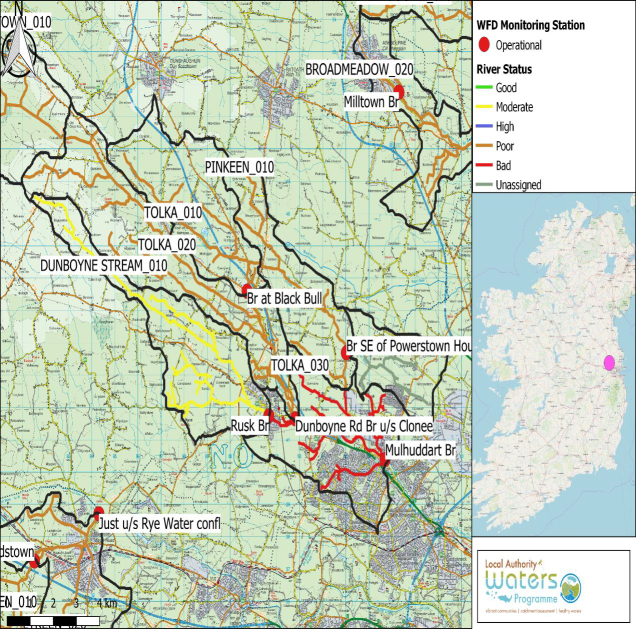
The Upper Tolka PAA covers an area of approximately 103.5km2 and includes the towns of Mulhuddart, Clonee and Dunboyne. The total land area included in the PAA is based upon the combined catchment areas of the upper section of the Tolka river and its incoming tributaries.

Kepak Clonee, Clonee, Co. Meath (Industrial Emissions Licence Register No. P0167-02)

Several high profile issues from the Kepac Clonee facility and Irish Water in recent years

Septic tank systems are deemed a significant pressure in two of the PAA waterbodies; the DUNBOYNE STREAM_010 and the TOLKA_010

Several farms identified with silage effluent flowing directly into stream and other farmyard issues.

Cattle access to river

Storm water overflows